
Programmatic Advertising Platforms: The Complete Guide to Automated Digital Advertising
In today’s fast-paced digital ecosystem, advertisers no longer rely solely on manual ad buying and guesswork. Instead, brands are increasingly turning to programmatic advertising platforms to automate, optimize, and scale their advertising efforts with precision. Programmatic advertising has transformed how digital ads are bought, sold, and delivered—making campaigns more data-driven, efficient, and measurable than ever before.
This comprehensive guide explores programmatic advertising platforms, how they work, their benefits, key components, types, popular platforms, challenges, and best practices. Whether you are a marketer, business owner, or digital advertising professional, this article will help you fully understand and leverage programmatic advertising for maximum ROI. As the Best Freelance Digital Marketer in Chemmad, I leverage advanced programmatic strategies to help brands reach the right audience, reduce wasted ad spend, and achieve consistent, measurable growth.
What Is Programmatic Advertising?
Programmatic advertising is the automated buying and selling of digital ad inventory using software, algorithms, and real-time data rather than traditional manual negotiations. It enables advertisers to purchase ad space across websites, apps, and other digital channels instantly and at scale.
At the heart of this ecosystem are programmatic advertising platforms, which connect advertisers with publishers and facilitate real-time bidding (RTB) for ad placements. These platforms use audience data, machine learning, and AI to ensure ads are shown to the right people at the right time and price.
What Are Programmatic Advertising Platforms?
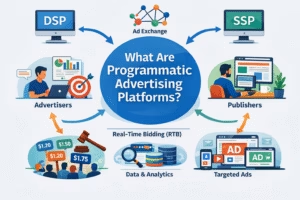
Programmatic advertising platforms are technology solutions that automate the media buying process. They manage ad inventory, audience targeting, bidding, placement, optimization, and performance tracking across multiple digital channels.
Instead of negotiating directly with individual publishers, advertisers use programmatic platforms to access thousands of websites, apps, and digital properties through a single interface.
Key Objectives of Programmatic Advertising Platforms:
- Automate ad buying and selling
- Improve targeting accuracy
- Optimize campaign performance in real time
- Reduce wasted ad spend
- Scale advertising efficiently
How Programmatic Advertising Platforms Work
Programmatic advertising operates through a highly interconnected ecosystem. Here’s a simplified step-by-step explanation:
User Visits a Website or App
When a user loads a webpage or app, available ad space is instantly identified.
Ad Exchange Sends Bid Request
Information such as user demographics, device type, location, and browsing behavior is shared anonymously.
Real-Time Bidding (RTB) Occurs
Advertisers bid on the impression in milliseconds.
Winning Ad Is Displayed
The highest relevant bidder’s ad is instantly shown to the user.
Performance Is Tracked and Optimized
The system continuously optimizes bidding, creatives, and targeting based on performance data.
This entire process happens in less than a second.
Core Components of Programmatic Advertising Platforms
1. Demand-Side Platforms (DSPs)
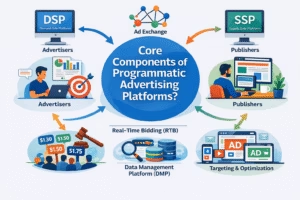
DSPs allow advertisers to buy ad inventory programmatically. Advertisers set budgets, targeting rules, bids, and creatives through DSPs.
Examples: Google Display & Video 360, Amazon DSP, The Trade Desk
2. Supply-Side Platforms (SSPs)
SSPs help publishers sell their ad inventory programmatically, maximizing revenue by connecting to multiple ad exchanges.
Examples: Google Ad Manager, PubMatic, OpenX
3. Ad Exchanges
Ad exchanges act as digital marketplaces where ad inventory is bought and sold through auctions.
4. Data Management Platforms (DMPs)
DMPs collect, analyze, and segment audience data to enhance targeting accuracy.
5. Ad Servers
Ad servers store and deliver ad creatives while tracking impressions, clicks, and conversions.
Types of Programmatic Advertising
Programmatic advertising platforms support multiple buying models:
1. Real-Time Bidding (RTB)
Ads are purchased on an impression-by-impression basis through open auctions.
2. Private Marketplace (PMP)
Invite-only auctions where premium publishers offer inventory to selected advertisers.
3. Programmatic Direct
Advertisers buy guaranteed inventory directly from publishers using automation but without bidding.
4. Preferred Deals
Advertisers get first access to inventory at a fixed price before it goes to auction.
Channels Supported by Programmatic Advertising Platforms
Modern programmatic advertising platforms support a wide range of digital channels:
- Display advertising
- Video advertising
- Mobile app advertising
- Native advertising
- Audio ads (podcasts, music streaming)
- Connected TV (CTV)
- Digital Out-of-Home (DOOH)
This cross-channel capability makes programmatic advertising a powerful omnichannel solution.
Benefits of Programmatic Advertising Platforms
1. Advanced Audience Targeting
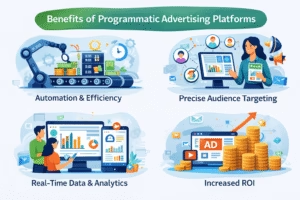
Programmatic platforms use behavioral, contextual, demographic, and interest-based targeting to reach the most relevant users.
2. Real-Time Optimization
Campaigns are continuously optimized based on performance metrics such as CTR, conversions, and ROAS.
3. Cost Efficiency
Automated bidding ensures advertisers pay the right price for each impression, reducing wasted spend.
4. Scalability
Advertisers can reach millions of users across thousands of publishers from one platform.
5. Transparency & Reporting
Detailed analytics provide insights into where ads run, who sees them, and how they perform.
Popular Programmatic Advertising Platforms
Here are some of the most widely used programmatic advertising platforms in the industry:
Google Display & Video 360 (DV360)
A powerful enterprise-level DSP offering access to Google’s inventory, YouTube, and premium publishers.
The Trade Desk
An independent DSP known for advanced targeting, cross-channel reach, and strong analytics.
Amazon DSP
Ideal for eCommerce and retail brands, leveraging Amazon’s shopper data for precise targeting.
MediaMath
A flexible DSP focused on transparency and AI-driven optimization.
Xandr (Microsoft)
Provides programmatic solutions with access to premium inventory and advanced data capabilities.
Programmatic Advertising vs Traditional Advertising
| Feature | Programmatic Advertising | Traditional Advertising |
| Buying Process | Automated | Manual |
| Targeting | Data-driven | Broad |
| Optimization | Real-time | Limited |
| Scalability | High | Moderate |
| Measurement | Detailed | Basic |
Programmatic advertising platforms clearly outperform traditional methods in speed, efficiency, and precision.
Challenges of Programmatic Advertising Platforms
Despite their advantages, programmatic advertising platforms also come with challenges:
1. Ad Fraud
Bots and fraudulent websites can generate fake impressions and clicks.
2. Brand Safety
Ads may appear alongside inappropriate or irrelevant content without proper controls.
3. Complexity
Programmatic ecosystems can be complex for beginners to navigate.
4. Data Privacy Regulations
Compliance with GDPR, CCPA, and cookie restrictions requires careful data handling.
Best Practices for Using Programmatic Advertising Platforms
To maximize success, follow these best practices:
- Define clear campaign goals and KPIs
- Use high-quality audience data
- Implement frequency capping
- Monitor placements and exclude low-quality inventory
- Test multiple creatives and formats
- Optimize bids based on performance insights
- Ensure compliance with privacy laws
Programmatic Advertising Platforms and AI
Artificial intelligence and machine learning are central to modern programmatic advertising platforms. AI helps:
- Predict user behavior
- Optimize bids automatically
- Improve targeting accuracy
- Detect fraud patterns
- Personalize ad creatives dynamically
As AI evolves, programmatic advertising will become even more predictive and performance-focused.
The Future of Programmatic Advertising Platforms
The future of programmatic advertising platforms is driven by innovation and privacy-centric solutions:
- Growth of cookieless targeting
- Increased adoption of first-party data
- Expansion of Connected TV and DOOH
- Contextual targeting resurgence
- Greater transparency and brand safety tools
Programmatic advertising will continue to dominate digital media buying as platforms become smarter and more privacy-friendly.
Who Should Use Programmatic Advertising Platforms?
Programmatic advertising platforms are ideal for:
- eCommerce brands
- SaaS companies
- Agencies and marketers
- Enterprises with large budgets
- Performance-driven advertisers
- Brands seeking scalable digital reach
Even small and medium businesses can benefit with the right strategy and budget control.
Frequently Asked Questions – Programmatic Advertising Platforms
1. What are programmatic advertising platforms?
Programmatic advertising platforms are software-based systems that automate the buying and selling of digital ad inventory using data, algorithms, and real-time bidding. They help advertisers target the right audience, optimize campaigns in real time, and scale advertising efficiently across multiple channels.
2. How do programmatic advertising platforms work?
Programmatic advertising platforms work by analyzing user data when a webpage or app loads, sending bid requests to advertisers, running real-time auctions, and instantly displaying the winning ad. This entire process happens in milliseconds and is continuously optimized based on performance.
3. What is the difference between DSP and SSP in programmatic advertising?
A Demand-Side Platform (DSP) allows advertisers to buy ad inventory, while a Supply-Side Platform (SSP) enables publishers to sell their ad space. These platforms connect DSPs and SSPs through ad exchanges to automate transactions.
4. What types of ads can be run using programmatic advertising platforms?
They support multiple ad formats, including display ads, video ads, native ads, mobile ads, audio ads, Connected TV (CTV), and Digital Out-of-Home (DOOH) advertising.
5. Are programmatic advertising platforms suitable for small businesses?
Yes, they can be suitable for small businesses if campaigns are well-structured with clear budgets and goals. Many tools allow flexible bidding, precise targeting, and real-time optimization, making them cost-effective even with limited spend.
6. What are the main benefits of using programmatic advertising platforms?
Key benefits include advanced audience targeting, real-time optimization, improved ROI, cost efficiency, scalability, detailed reporting, and reduced manual effort in ad buying.
7. How is programmatic advertising different from Google Ads?
Google Ads is a tool owned by Google that includes programmatic features, while other solutions provide broader access to multiple ad exchanges, publishers, and channels beyond Google’s network, offering more flexibility and reach.
8. What is real-time bidding (RTB) in programmatic advertising?
Real-time bidding (RTB) is an auction-based process where advertisers bid for ad impressions individually in real time. These systems evaluate bids and relevance to determine which ad is shown to the user.
9. Is programmatic advertising safe for brand reputation?
Programmatic advertising can be safe when proper brand safety tools are used. Most solutions offer placement controls, blocklists, whitelists, and fraud detection to ensure ads appear in suitable environments.
10. What data is used in programmatic advertising platforms?
Programmatic advertising platforms use first-party, second-party, and third-party data such as user behavior, demographics, interests, device type, location, and contextual signals to improve targeting and performance.
11. How do programmatic advertising platforms handle data privacy?
Modern programmatic advertising platforms comply with data privacy regulations like GDPR and CCPA by using consent-based data collection, anonymization, and cookieless targeting methods such as contextual and first-party data strategies.
12. What industries benefit most from programmatic advertising platforms?
Industries such as eCommerce, real estate, education, finance, travel, SaaS, healthcare, and entertainment benefit significantly from programmatic advertising platforms due to their scalability and precise targeting.
13. What is the future of programmatic advertising platforms?
The future of programmatic advertising platforms includes increased use of AI, growth in Connected TV and audio ads, cookieless targeting, first-party data activation, and greater transparency in media buying.
14. How can I improve results with programmatic advertising platforms?
You can improve results by defining clear KPIs, using quality audience data, testing multiple creatives, monitoring placements, optimizing bids regularly, and applying frequency capping and brand safety controls.
15. Do programmatic advertising platforms guarantee conversions?
No platform can guarantee conversions, but programmatic advertising platforms significantly improve the chances of higher performance by optimizing targeting, bidding, and ad delivery based on real-time data and user behavior.
Conclusion
Digital advertising has been transformed by intelligent automation that replaces manual buying and selling processes. This approach enables advertisers to reach the right audience, at the right time, on the right channel while continuously optimizing performance in real time.
By understanding how this technology works—along with its components, benefits, challenges, and best practices—businesses can unlock powerful growth opportunities in today’s competitive digital landscape. With the right strategy and execution, brands can significantly improve targeting accuracy, efficiency, and return on investment.
As technology continues to evolve, automated advertising will remain at the forefront of digital marketing—making it an essential strategy for brands aiming to scale, optimize, and succeed online. Partnering with the Best Freelance Digital Marketer in Chemmad ensures expert-driven advertising strategies that deliver measurable results and long-term digital growth.
- Optimize this blog for SEO (meta title, meta description, FAQs, schema)
- Rewrite it for agency website / personal brand
- Add internal linking + call-to-action sections
- Convert it into short blog, LinkedIn article, or carousel contentvisit more blog